

What is the difference between a semi - automated and a fully - automated biscuit production line?
Nov 10, 2026
Leave a message
Hey there! As a supplier of biscuit production lines, I often get asked about the difference between semi-automated and fully-automated biscuit production lines. So, I thought I'd take a few minutes to break it down for you.
Let's start with semi-automated biscuit production lines. These bad boys are a bit of a mix between manual and automated processes. They've got some cool automated features that help speed things up, but there's still a fair bit of human input required.
For example, in a semi-automated line, you might have a machine that mixes the dough automatically. You can check out a Factory Large Volume Dough Mixer Flour Mixing Machine for Cake that could be part of such a setup. This machine takes care of combining all the ingredients to make that perfect dough consistency. But once the dough is ready, it might need to be manually transferred to the next step, like shaping the biscuits. Workers usually use some simple tools or semi-automated presses to shape the dough into different biscuit forms.
After shaping, the biscuits are often placed on trays by hand, and then these trays are loaded into an oven for baking. The oven might have some automated temperature and time settings, which is great, but someone still has to keep an eye on it and make adjustments if needed. And when the biscuits are done baking, they're usually removed from the oven manually and sent for the next stage, like packaging.
One of the big advantages of semi-automated lines is that they're more affordable. If you're a small or medium-sized biscuit maker just starting out, or if you have a limited budget, a semi-automated line can be a great option. You don't have to shell out a huge amount of money for a fully automated setup. Also, they're more flexible. You can easily adjust and modify the production process based on your needs. If you want to change the shape or size of the biscuits frequently, it's relatively easy to do with a semi-automated line.
However, there are some downsides too. Since there's a lot of human involvement, the production speed is slower compared to fully automated lines. And the quality can be a bit inconsistent. Different workers might shape the biscuits slightly differently, or the baking time might vary a bit from batch to batch. There's also a higher risk of human error, like forgetting to adjust the oven temperature or accidentally misplacing the biscuits on the tray.
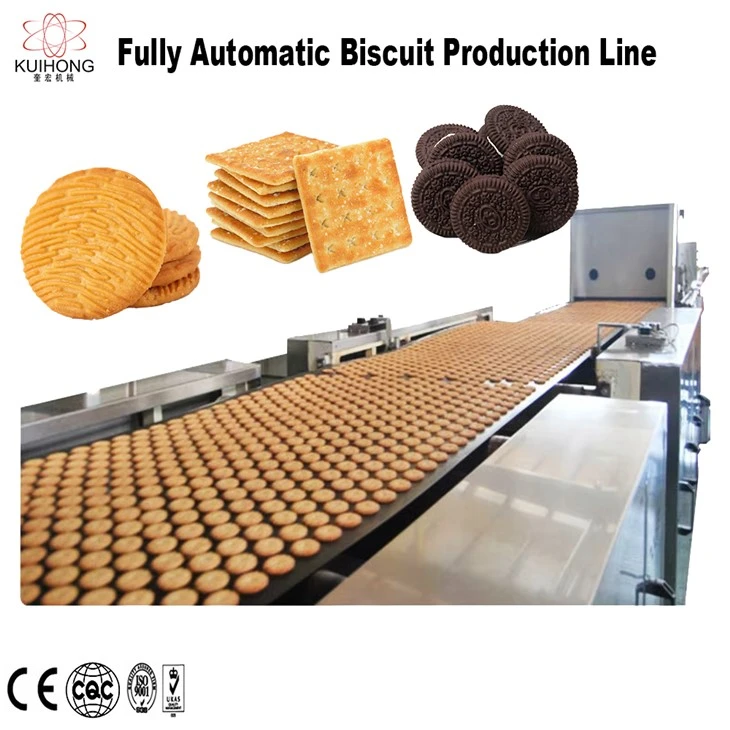
Now, let's talk about fully-automated biscuit production lines. These are like the superheroes of biscuit making! They're designed to handle the entire production process with minimal human intervention.
It all starts with the dough mixing. Just like in the semi-automated line, but here, the whole process is seamless. The machine measures the exact amount of each ingredient, mixes them up to perfection, and then transfers the dough directly to the shaping section.
The shaping is done by high-tech machines that can create all sorts of biscuit shapes with incredible precision. For instance, you could have a Full Automatic Small Bear Centre Filling Biscuit Machine For Core Biscuit that not only shapes the biscuits but also fills them with delicious centers. It's like a little biscuit factory in itself!
Once the biscuits are shaped, they're automatically transferred to the oven. The oven is programmed to maintain the exact temperature and baking time for each type of biscuit. There's no need for someone to stand around and watch it. After baking, the biscuits go through a cooling process, and then they're sent straight to the packaging section. The packaging machines can wrap the biscuits in different types of packaging, like bags or boxes, at a really high speed.
The biggest advantage of fully-automated lines is the speed. They can produce a massive quantity of biscuits in a short period of time. This is great for large-scale biscuit manufacturers who need to meet high demand. The quality is also very consistent. Since there's less human intervention, every biscuit looks and tastes the same. There's also less risk of contamination because the whole process is enclosed and controlled.

But, of course, there are some drawbacks. The initial investment for a fully-automated line is huge. Buying all the high-tech machines and setting them up properly can cost a fortune. Also, these lines are less flexible. If you want to make some changes to the production process, like changing the biscuit recipe or shape, it can be more difficult and time-consuming. You might have to reprogram the machines or even replace some parts.
Another thing to consider is the maintenance. Fully-automated lines are complex pieces of machinery, and they need regular maintenance to keep running smoothly. You'll need to have a team of skilled technicians on standby to fix any problems that might arise.
So, which one should you choose? Well, it depends on your specific situation. If you're a small business with a limited budget and you want to have more control over the production process, a semi-automated line might be the way to go. On the other hand, if you're a large company that needs to produce a large volume of biscuits quickly and with consistent quality, a fully-automated line is probably a better option.
If you're interested in learning more about our biscuit production lines, whether semi-automated or fully-automated, feel free to get in touch. We've got a range of products, including a Soft Biscuit Making Machine, that can meet your specific needs. We can help you figure out which type of line is best for your business and provide you with all the support you need to get started.
Let's have a chat and see how we can work together to take your biscuit production to the next level!
References
- General knowledge in the biscuit production industry
- Experience as a biscuit production line supplier